
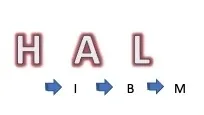
HAL
“It ain’t what you don’t know that gets you into trouble. It’s what you know for sure that just ain’t so…”
Mark Twain
IBM CEO, Arvind Krishna, did a podcast for Decoder in December first. For many who may not be tracking the various sundry vicissitudes of IBM ‘strategy’ over the years, IBM is a pioneer in AI. Remember the HAL 9000 from the movie 2001 A Space Odyssey? That was 1968.
Somewhat ironically, they went further back in time in 2011 with Watson who won Jeopardy back when Television was a thing – of course, the Watson family were the founders of IBM. IBM leadership in those days subsequently crashed the AI ship into the Healthcare iceberg, which is currently enjoying mountains of cash built upon the backs of indebted consumers and whiney Fortune 500 companies under an unsustainable business model of parabolically escalating premiums. AI didn’t do much good for the Healthcare industry then and we’re not seeing much benefit now. Seems like an opportunity.
IBM purchased RedHat in 2017 while jumping back into the box as it were in a big way, realigning their business on Systems (computers), enterprise Software, and Professional Services. That’s all good, but at issue here is the topic of Data Centers in the context of AGI, an acronym for Artificial General Intelligence. Krishna does not think AGI is anywhere near achievable in the short run. AGI as defined by Dictionary.com, is ‘a theoretical type of artificial intelligence capable of performing cognitive tasks at a skill level equal to or greater than that of a human.’
Bruh, we’re not so sure about that. From a pure calling up knowledge of random facts, AI is already much smarter than the Average General Individual we encounter walking through the local Costco during the holidays. In terms of cognition though, we all know that we are a long way from the computer science definition of AGI. The chief spokesperson of AI, Sam Altman, or Musk, or Zuckerberg, like it or not, might talk about AGI but it remains more of an aspiration than a market reality.
That said, Uncle Arvind knows a lot of things about technology, and he happens to be a rare executive of high moral character. But like a conversation with Allen Greenspan, you need a LLM and an interpreter to parse what he’s really saying. What you might not know is that he also used to have a Data Center / Infrastructure Services business, Global Technology Services, that he jettisoned back in 2020 called Kyndryl. This is what he had to say about Data Centers during the podcast:
It takes about $80 billion to fill up a one-gigawatt data center. That’s today’s number. If one company is going to commit 20-30 gigawatts, that’s $1.5 trillion of CapEx. To the point we just made, you’ve got to use it all in five years because at that point, you’ve got to throw it away and refill it. Then, if I look at the total commits in the world in this space, in chasing AGI, it seems to be like 100 gigawatts with these announcements. That’s $8 trillion of CapEx. It’s my view that there’s no way you’re going to get a return on that because $8 trillion of CapEx means you need roughly $800 billion of profit just to pay for the interest.
Our view is the Data Center business itself, and the ample sums that the Tech Bros are pouring into it through the pursuit of AGI or straight up greed, are not really a good example of the opportunity or even a sound barometer of the overall health of the IT industry. AGI is the moonshot program not the mission at hand. Furthermore, AI is but one example of the applications that need to live in new and improved Data Centers, like those with actual electricity.
As we have articulated many times, Data Centers are everywhere. Even Jeff Bezos is talking about Data Centers in outer space and not to be out done Sundar Pichai thinks ‘extraterrestrial’ Data Centers are a thing which is a galaxy far, far away at this stage, but they are becoming ubiquitous almost everywhere else and much closer to home; like the local movie theater, your local big box retailer, the beloved professional sports stadium, and yes, even the International Space Station (ISS) are all examples of active Data Centers.
Are these Data Centers too expensive. Probably. We would argue that large tech companies are extraordinarily inefficient at building and operating Data Centers let alone power plants. But perhaps, even more critically, is the revamp of the energy infrastructure across the US taking place under the covers as it were, which is in desperate need of an extreme makeover. In our view, while they might be less efficient now, innovations will emerge. We all need Technology companies continued spending billions on Data Centers and AI in part as a broader race for modernization of America’s workforce, our infrastructure, and our way of life. AI is but one of the application stops along the way and we predict as it has in the past, it will be with us in perpetuity at this point.
Henry Chandonnet summarized the Podcast in an article on December second. It’s always interesting what people take away in an attempt to break things down in laymen’s terms. Our translation which is of course an opinion and is below for each item:
- IBM’s CEO walked through some napkin math on data centers— and said that there’s “no way” to turn a profit at current costs – TRANSLATION: There is not enough profit in Data Centers for IBM to invest in them. Hence, they exited the business.
- “$8 trillion of CapEx means you need roughly $800 billion of profit just to pay for the interest,” Arvind Krishna told “Decoder.” TRANSLATION: IBM is hedging its own AI investments and will not be seeking outside funding to finance. Expect layoffs of 10% everywhere except developers which continue to be in high demand across the board.
- Krishna was skeptical that current tech would reach AGI, putting the likelihood between 0-1%. TRANSLATION:AI is still an error prone science experiment where the number one concern by business leaders is accuracy of results. Big opportunity for the consulting business short term. Long term, IBM’s putting its money in the box – Quantum computing is their bet where they continue to enjoy a comparative advantage relative to other competitors in this market.
Nobody really knows how Quantum will impact Data Centers with total precision. At CloudNineData we have insight in this area for those who are interested in learning more. One thing is for sure, Quantum is a compounding factor, a function of multiplication rather than subtraction. Quantum will enjoy a greatly modernized infrastructure at lower costs in about three years’ time when it becomes mainstream because of the investments being made today by team Trump, aka the Taxpayer, and the Tech Bros complex. It’s always a plus to use other people’s money.
We think IBM is a BUY.